Tuesday, September 8, 2015

Santiago Day 4

I forgot to mention yesterday that people put sawdust down on the entryway to stores and restaurants to keep people from slipping on the rain. A lot of the floors are tiles and stone and quite slippery! It's always funny how people in other countries do things.

We scheduled a wine tour for today and were ready downstairs at 8:10 as scheduled. They ran around 20 minutes late, enough time to make me sweat it as I read the paperwork last night (of course!) and read I was supposed to reconfirm 24 hours in advance. Thankfully they did come. J

We met up at a large mall and there were several busses for their different tours. We got on a shuttle van for Maipo region and headed off. Our guide was named Daniel. He was born in Chile but grew up in Denver, and moved back a few years ago as his mother was ill. His English and Spanish were both very good.

Santa Rita is one of the most important vineyards, producing 78 million liters of wine a year. Underraga produces 100M and Concho Y Toro 300M liters (Chile, California and Argentina- Mendoza).

Just under 1.3 billion liters of wine are produced in Chile, and most are exported (70-75%). Chileans only drink around 13 litres per year on average. They drink more pisco (30-45% alcohol) and love piscola drinks (pisco mixed with cola.) In the 1800s there was a German and Croatian immigration which brought beer to the region, and now beer and piscos are the main drinks in Chile.

Cabernet is the #1 wine produced. Mendoza was nominated as a ‘great wine capital of the world’ and Cassablanca, the region between Valparaisso (coast) and Santiago was also bestowed with this honor. They produce more white wines (sauvignon blank and chardonnay), and Maipo more reds. Overal Chile produces more red than white, and 70% of the production is red.) Carmenere, from France, is another famous wine from this region, and it’s exported to over 130 countries. Most of the wine is produced by French grapes brought over by the Spaniards.

The Incas controlled Columbia through South Chile until the 1500s. in 1536 the first Spanish expedition entered Chile, but they were not prepared for the altitude and many died on the way. Chile is 4,000 meters above sea level.

There are 2,000 volcanoes in Chile, and 60 are active. The last eruption was on 4/22/15 in south Chile.

Top exports are copper (50-55% of income), wood and salmon.

We are visiting in the winter so the vines are all dormant and have no green, but the vineyards look like those I’ve seen in the states, flocked by the shadow of the Andes in the far background. Santa Rita has a large colonial-style hacienda that is a rust brown with white trim and pillars. It’s very foggy today and cold!


We learned the irrigation is drop-to drop with a long pole with holes, created in Israel. The vines get two hours of water every other day in season. January brings the blooms, march through June the harvest; and June is late harvest grapes (sweet dessert wines.)

The oak barrels used to store and age the wine comes from the US and France. Local oak doesn’t work because the wine becomes too oxygenated. The French are the best and most expensive and used for the higher value wines. Oak barrels can be used up to five times. The best wines get the first use of the barrels and are stored 18+ months.


Our guide at the winery was Victor. The owner and founder was a woman named Mrs. Paula. In 1780 the land was a hacienda and in 1790 the house was built. She was a patriot from a wealthy family and aided the fight for independence by housing 120 soldiers, hidden in the basement. She nursed them and allowed them rest, then they went back to fight the Spanish for independence. There is a wine called 120 to pay homage.

In 1880 the hacienda became a vineyard. They produce petite syrah, syrah carmenere, cabernet frank, merlot, cabernet sauvignon, sauvignon blank and chardonnay. Located in the valle del Maipo (valley of Maipo) near the Andes. The location is rainy in the winter and summers are hot and dry. Reds are best produced here. The vineyard has 1200 hectares of land.

The vineyard believes the 30-90-year old vines are the best for producing quality wine as the roots are deep and absorb nutrients. The wine is a more concentrated and a better flavor. At the end of each row of vines is a rosebush. The purpose is to draw any insects and impurities—rose bushes are fragile so they will tell the state of the vines and alert to any issues.

Young wines take 6-8 months to produce and are not aged in barrels. Reserva is aged in American oak barrels for around 8 months and Gran Reserva in French oak barrels for a year or more. Prima also uses French oak but brand new barrels and is aged 18-24 months. 225 litres are in a barrel. Santa Rita only uses barrels three times then sells to pisco, chichi or other distilled liquor makers.

Nitrogen is added to protect the wine from oxygen, and we got to watch this process. The wine cellar was made in 1880 of brick with mortar of limestone, sand and egg whites. In 2010, the earthquake caused damage to the cellar and two of the large pillars had to be replaced with concrete. They also lost around 20% of the wine production.

The grounds were beautiful as was the hacienda. There is also a museo Andino (Andes museum) on the grounds that we toured, including pre-columbian artifacts and items from all of Chile including Easter Island.


The wines overall were good. The first, a white, was not, but the reds were both good. I bought a bottle of Reserva Syrah.


We stopped at a restaurant for lunch. Kim got lomo soltado, her new favorite, and I got a ‘special dish’ called plateada al jugo. It was like beef brisket but it was cold. I’m not sure if it was supposed to be but assumed so. Hmmm.. it was ok but not what I expected. The salad I got ended up being cut up tomatoes, canned green beans (this is the second time green beans were canned, so apparently that’s the thing here) and avocado, with no dressing.

We then drove to the last vineyard, Conca y Toro. The house was built in 1875 as a summer home for the founder Mejor Concha y Toro. He was a politician and business man. There are 22 rooms and 4600 square meters in the light yellow house, which is now office space. There are 23 hectares of garden with many kinds of trees, a pond, some chickens, a sheep and a few other animals freely roaming.


This vineyard grows 26 types of grapes, 13 red and 13 white. This is the largest winery in the world and includes Chile, Mendoza Argentina and California. They produce over 300M litres of wine and are the 4th largest producer in the world. They have an old cellar and a modern cellar. The old cellar looks similar to the one at Santa Rita, with brick held by mortar of limestone, sand and egg whites. Castillero del Diablo is stored here. The cellar was built around 1850 and the best wines are stored here. It is named that for security—people were stealing so they started a story that the devil had been seen here, and people were too scared to go there!!


The white sauv blank was ok here but the two reds were not good at all, in my opinion. I dumped them after a sip or two, if that tells you anything. Shocking! Lol.

We drove back and dropped off people in Santiago then were dropped a block from our place. We went to the store to grab a few things for dinner instead of going out again, as we had a large lunch. That stuff included two local pastries: pastel manjar pruve (not sure what this is. It's layered with very thin layers of cake and caramel with maybe 12 layers. Very good and sweet!) and pastel mil hojas ('thousand leaves delicacy cake.') http://www.enmicocinahoy.cl/2012/03/mil-hojas-manjar-huevo-mol/ It's interesting.. layers, but not like phyllo dough, and fairly dry but sweetened with caramel.

We decided to do some laundry as tomorrow may be a long day, and since we have to leave by 7 to get to the airport on Thursday, this way we’re not rushed. Exciting stuff. Since we’re in a high-rise tower, we sat in the laundry room waiting for our laundry to finish. I so appreciate my washer and dryer in my house!!


Monday, September 7, 2015

Santiago Day 3

Hello from soggy Santiago! I woke to the sound of pouring ran (POURING should be in caps.) We slept in a bit and got ready slowly, braving the rains to head out. We went to Santa Lucia hill but it was closed due to the weather (it's a very steep hill.)


We walked around the base to an artisinal market (Feria artisinal Santa Lucia) full of local and Peruvian wares, but nothing really piqued our interest. We walked around the Catholic University and through a small part of it ornate with pillars and statues inside-- nothing like the school either of us went to! We walked a bit through that areas then walked back over Lastarria to find a place for an early lunch. Many places were closed or empty, and we settled on Sur Patagonica restaurant again for their sandwiches which looked SO good when we were there last.


They were every bit as good as expected, yum! We got pisco sours (why not?) and split a panquequa de dulce de leche (crepes with caramel.) Still as good.. yum! I enjoyed an espresso and we braved the elements again.

It was pouring much harder this time. We walked through the Italian Plaza, and through the Parque forrestal. We were going to head towards the Plaza de Armas for post cards to send my nephews, but it really started pouring badly so we went back to the room to dry off. And nap. Out cold we went and really needed it.

We decided to walk a bit more then headed our for Peruvian food in "Little Peru" as our apartment owner calls. Maybe a ten minute walk away, there are several blocks of peruvian restaurants all in a row. This one was really good! We got cevice, pisco sours (of course). Kim got a fried chicken crusted with quinoa and green rice and I got steak with green rice risotto. Very tasty.

It was raining again when we were done so we made our way back to our apartment, then went up to the roof deck to see how the view was with night lights.. decent. :)


 Tomorrow we venture out of the city for a wine tour in the Maipo region. Looking forward to it, and hopefully some blue skies!

Sunday, September 6, 2015

Santiago Day 2

It was so dark when I woke up this morning that it was hard to believe it was 7:30! We have a four-hour walking tour at ten so we got moving a little after 8. Made breakfast from the fixin's we got at the store yesterday (after scrubbing everything we used!), and fueled and on our way! 

What a fun day!!! We decided to do a free group tour that was highly recommended (thanks Tripadvisor!) We met at Plaza de Armas. Phillipe was our guide and he was wonderful! Native to Santiago, and an actor by trade, he did the tours for some stable income. He was interesting, engaging and fun! 

Plaza de Armas is the 'heart of the city.' It was the first thing build by the Spanish when they arrive to the valley of Santiago. The Catedral Metropolitano was the second oldest cathedral in the area and started in the 1500s and completed in the 1700s. Several renovations had been done due to earthquakes. One hit around five years ago and was a 7.9!

Correo Central is on the square near the Catedral and is where the presidents used to live. Now it's the post office, and the fanciest one in Santiago. The yellow building next to it was the courthouse but is now the national history museum.


He shared that people who lived towards the mountains were wealthier, and those living towards the highway are poor. A sad but true demarkation.

The plaza is usually bustling with people- priests, entertainers, general people. On Tuesdays they show opera and on Thursdays have salsa dancing. Today was very slow as it was drizzling and a Sunday.

Don Pedro de Valdivia arrived in 1541 seeking the golden city of El Dorado, and founded Santiago. He moved here from Peru also because he was having an affair and wanted to get away from the power of the Catholic Church and the Inquisition. The Church and Inquisition did eventually call him back and made him give up his affair. There was an Inca settlement in the valley, so his people settled on top of it. The Mapuches are the native tribe in much of Chile and represent around 10% of the people now. Many of the other tribes are gone now though 1 million Mapuches live in mostly southern Chile. There are 6 million in Santiago and close to 15 million in Chile.

Congress is now housed in Valparaisso, though used to be in a building in Santiago. The members are complaining about the 1.5 hour drive, so it may be moved back in the future.

We walked past the Museu Chileno de Arte Precolumbian, one of Phillipe's two favorite museums in Chile and on list. Unfortunately we learned the museums in all of Chile are closed on Monday, and that was the day we will have the time to go. So.. we'll see! 


I learned that there is a local drink called chicha. There is one in Peru that is corn-based, and one in Brazil that is different too.. the one in Chile is apple cider (alcoholic.) Yum! In search of chicha!

We walked past Café Caribe and Café Haiti. They are among the group of cafes called Café con Piernas, or cafes with legs. The owners pay women to wear short skirts and entertain the business men who frequent the café. At times they will close the café to have the women dance. Generally the women are foreign. They have been around for more than 20 years and are throughout the downtown.

We walked to Moneda Palacia and La Plaza de Constitucion, the Presidential Palace. It used to be the mint (moneda is coin in Spanish.) The current president is a woman named Michelle Bachelete.

There is a statue of Salvador Allende in the Plaza. He was the first socialist elected in a Democratic way. He did much for the country in the 1,000 days in office including nationalizing copper (there are large mines in northern Chile) and made primary and secondary schools free. He was a friend of Castro but much loved by the populace. Unfortunately for him, he was not loved by the wealthy in the country and they forced an economic collapse. On 9/11/73 the presidential palace was bombed and he lost power.

We were lucky to see the changing of the guard, which only happens every couple of days. It was impressive and went on for well over 30 minutes. It started in the courtyard with a small group, then a marching band led by horses arrived from the street to join them. Among the marching band-style music were other pieces that sounded like they were from a symphony. The band was quite impressive. The music differs each time and usually is more brief over the weekdays.


There has been a fairly extensive police presence in the city. Phillipe said it’s not usual and he thinks maybe something is going on to call for it. He said crime is low in Santiago but has risen a bit, so some of it is to stop that.

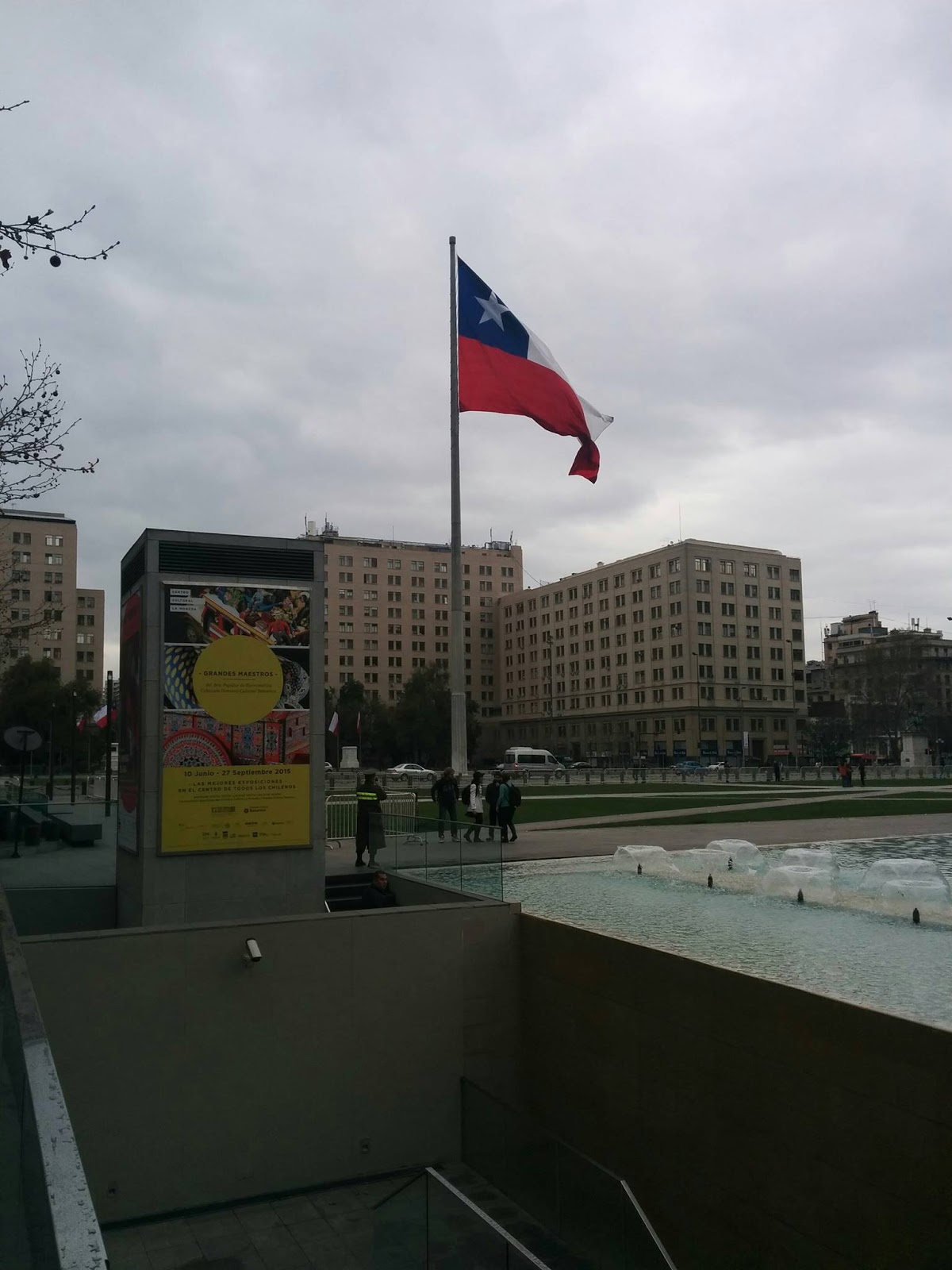
Behind the palace is the largest flag in the country, and one of the largest in the world. Citizen square has many fountains/water features and celebrates the 105th anniversary of Chile as a nation.


Pinochet took over after Allende. He was intended to rule for one year in a transition government, but held power for 17 years until he was voted out. This military dictatorship held power through fear, and many were killed for not supporting it. Many people left and went to Sweden (100k), also Canada and Australia. Pinochet was arrested in London in 2005 and finally brought to Chile for trial, but he died before he was brought to justice. There is a Human Rights Museum that Phillipe said is one of his two favorite museums and worth seeing, about this dark time in history.

We then walked down Alameda street, the main street in Santiago. We passed the main building of the University of Chile and the Santiago Stock Exchange, at the end of "New York Street." 


Phillipe talked about some of the issues living in Chile, especially the large gap between the rich and the poor. He said a living wage in the country is $950/month and minimum wage is around $450.

We passed Teatro Municipal (opera house) next to Subercaseaux, the French Palace.


We then arrived at Santa Lucia hill, close to where we are staying and walked around it. It was originally a pile of rocks and a sacred place for the Mapuches. Many were killed there when the area was being controlled. It later became a park built by prisoners. We walked to Lastarria, where we ate dinner last night. It has many restaurants, a theater and is considered a cultural center of Santiago. We stopped in a restaurant called Mulato for a break and enjoyed a pinot empanada (chopped meat, onion and olive.) Very good! They served it with a spice called merkem, served in a mortar and pestle. It was smoky and spicy and very good. One of the girls in our small group got a pisco sour and let us try it. It was the best so far!


We walked through Parque Forestal, a large park in the center of the city and crossed a main road to get to the Bella Vista neighborhood. You can see San Cristobal from the entrance to this neighborhood, the highest point in the city. We walked by the German Fountain, a gift for the 150th anniversary of the country and a memorial of German immigration. In the distance we could see the Italia Square, which held large celebration for the world cup win—the first time in history Chile won.


Bella Vista is a very diverse neighborhood with many bars, dance clubs, restaurants. A lot of students are in the area and there are two large Universities. We walked through Patio Bella Vista, a large area of many restaurants and some retail shops. Phillipe pointed out many recommendations, several of which were on my list to try. He did suggest we make sure the prices are listed on the menu, or we might be charged more than is fair.


We walked past Castillo Rojo, a German building that is now a very expensive hotel, and ended to tour at Pablo Neureda’s house, La Chascona. He was a much-loved poet who won a Nobel price (only one of two Chileans with this honor, and interestingly, the other was also a poet.) He was a friend of Allende and considered a threat to Pinochet. He was believed to have died from cancer, but there was speculation that he was poisoned. More later about La Choscarra..

We decided to go to the top of San Cristobal as the weather cleared a bit and though it was cloudy, it was bright with no rain. We took a funicular up and the views were amazing! This city is quite huge, and seems every bit as large as Paris, though I know that’s not possible. It seemed to extend in every direction for as far as the eye can see! At the top is a large monument of the Virgin Mary and a small simple but beautiful church.


When we got down we decided to tour La Chascona, which means women with wild hair/a lot of hair. Pablo Neureda was married, but had a mistress whom he named the house after. He carried on the affair for some time, then left his wife for her and lived with her for the rest of his life. The house was their private residence, then became a museum. He had two other houses, one in Valparaiso, where we will be in a week. The house consists of several buildings, one included a bar and dining room, another a living area, and sleeping quarters, and another a summer bar (why have only one bar?), a library, and a writing room.


The house was interesting. Pablo was a collector and had an incredible amount of pieces including pottery, paintings, glass, sculptures and books, some of a lot of value. The grounds were beautiful.

After that we headed back to the patio Bella Vista to see if two of the people from the tour were there still, but they weren’t. We got a drink and people watched a bit, then went to Galindo for dinner. It’s a famous Chilean food restaurant and was packed the few times we walked by. It was very affordable but I was a little disappointed.. I ordered spicy shrimp. The waitress came back to ask if I wanted anything else as it was only shrimp, so I got a salad. There were few small shrimp, no spike and the salad was ok but nothing great. Oh well! Kim got steak with grilled onions over French fries.. a large plate.


We decided to stop for desert, and went to Emporio la Rosa, recommended as the best ice cream in Santiago, on our way home. Phillipe recommended a honey ice cream called miel de ulmo so we both tried that with another flavor. It was ok but not very creamy. Both of us figured that if this is the best that Santiago had to offer, we would try other desserts.


We made it back to our place, almost 12 hours after we left, tired and happy. Quite a fun day!! Internet is quite painful tonight so loading these is taking forever. And our phones have very limited internet.. it's mostly when we have wifi access in the room, and then it's patchy. Given that Kim paid for access and I am supposed to have it while in Chile, it's a bit of a pain. thankfully all is well at home so there's no urgency.

Alright, hitting the hay. I'm tired and a bit achy from walking so much tonight. Hoping the weather will improve from the day of showers expected as the musuems are closed!

night, all!
s